Showing posts with label chute. Show all posts

Tuesday, October 21, 2014

It’s Time to Trial (well, kinda of)

I only say this because I could trial tomorrow, but it’s not looking like I’ll actually MAKE a trial until after the new year. So, don’t get excited.

I last left you pretty frustrated but trying to make the most of it with Rippa. I keep saying it’s not linear but we so want it to be! Rippa refusing to work ducks and turning off on Stephanie’s sheep made me take a step back and re evaluate my goals, my dog, and, most importantly, my beliefs.

You don’t get into dog training unless you’re a control freak in one way or another, and that can make it really hard to believe in something because EVERYONE believes in something and if you’re not lock-step behind them, you’re going to have some trouble with it.

As I get older and get better at being me (aka, living in my own skin), I’m doing a lot better on the realizing this earlier and making calls. Same with Rippa. After talking to Joey Judd about what his dogs were/are like, I have to remember that it was never my goal to have perfect trial dogs. There are plenty of those. I don’t need perfect family dogs. There are scads of those. What I need is a dog that I can say to a rancher – this dog will take minimal training and help you. These things can include the others, but they don’t have to.

And so, I backed off all the fine tuning stuff, no circling around the stock and me to set up drives, no hard flank work, none of it. Just fetching and setting up chores. And, taking advantage of the fact that I have all the time in the world, not letting the dogs actually work.

Rippa hasn’t been on ducks for a while now, but she’s got to watch Fury do it and it’s driving her nuts. Good. Be bummed about missing out. We’re taking a break because I’m deep in my work season right now anyway, but when I go out again, it will be to torture Rippa by working Fury again. Muahahaha.

I realized I had some holes in Rippa’s training and have started taking Stephanie’s sheep out to a big alley way to work on driving, control, etc in tight spaces. She is learning that she can drive easy and still control (rather than chase because they’re running away) and she can’t get out wide enough to go to their heads at a full run, but she’s able to do it in the narrow chute if she approaches slowly and easily. I’m keeping sessions short and positive and Rippa is happy.

20141021_145857_HDR (1)

Sooooo happy. She’s tired.

We’ve been working on obstacle stuff with Shannon’s help, too. She’s learning that non-takepen/holding pen obstacles don’t mean she has to lose her stock and she’s figuring out to make that happen, as well as negotiate obstacles in general (aka, in her way). Shannon and Dustin’s setup is a lot tighter than Stephanie’s because their training goals are different. I really like the balance because we can work on distance and outruns at Stephanie’s and work on all the nitty gritty stuff at the Woods and come up with  a balance.

Rippa’s mom Fury is coming along, too. Today I actually had a thought that I might be able to finish her WTCh in her old age if I pick my cattle well. (I don’t need her getting hurt to do it.) We’ve been working short sessions with her on sheep and she’s learning to balance and that I hold my end now.  The difference between when she started with Stephanie's sheep to today is night and day. I’m definitely going to finish her started sheep title (she needs a leg) and ducks when I’m ready to go out there. It’ll take more mellow control on her part to get to open, but I’m feeling like its possible. Stephanie thinks it’s much to do with her getting older, and that might be it, but I like to not think like that. Fury isn’t much different at almost 12 as she was at 4 in temperament or physical ability – I’ve noticed it’s harder for her to climb stuff, but she still does it – what’s changing is MY attitude and MY handling more than her aging.

One of the things I’ve started doing before working is taking my time with that. I lay the dog down outside the gate and give flanks until they stop thinking STOCK STOCK and start listening to my commands. When they ease up and take them, I go to the gate, drop them, and walk in, leaving them. I might move the stock around a bit until the dog eases up and lets it be my job before I let the dog in. This is working brilliantly to get soft, easy starts at the first go.

So, no, it’s not linear. I went back to basics with Fury and Rippa, but it’s going well and I’m getting more out of them both. Fun fact: I was a college professor for almost a decade and occasionally I would substitute for junior high and high school. What I taught at the college level was the SAME thing being taught in lower levels.

It’s not linear. We learn, we use, we stop using, we forget. One must always go back and work on the basics to get advanced work, even if it’s just a tune up. ESPECIALLY if you don’t use it very often or consistently.

20141021_135755_HDR (1)

The Naked Fury

Sunday, July 20, 2014

Curt Pate Part 2: The notes

You can read part 1 here.
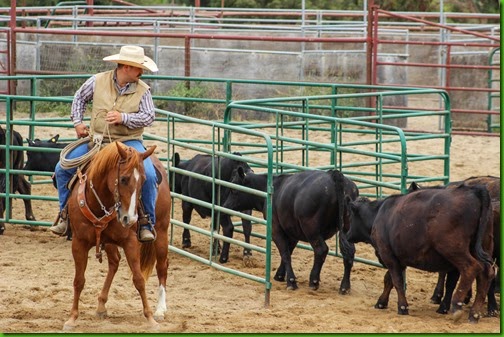
IMG_0122Dustin Wood uses his horse’s butt as a wing (as mentioned below).

Mr. Pate’s cattle clinic was one of the best clinics I’ve been to for a number of reasons:

  1. It was ridiculously cheap.
  2. I understood the stock more clearly than I ever have. We always focus on our dogs and the stock aren’t really as much of the equation. They should be. This clinic helped me get there.
  3. The first hour or so, I basically felt like I had a lot of work to do (especially if I want to trial on horseback . . . those horses take a LOT of work).
  4. Some things that I’ve been feeling out but not told got solidified. I think I’m definitely at the beginning stages of mastering this stuff in that I can see things, and I can also see things I don’t know.

Curt started his clinic with everybody on horseback as he lectured about what he did, and then he took to doing warmups with the horses. I thought this was great. I’m sure everyone was wanting to get to the good stuff (moving cattle), but reality is a good check. Is YOUR team fired up?

General Thoughts

Think of this as smooth stockmanship – that’s how he thinks of low-stress stockmanship. No hurky jerky. Things just flow. Look for it. Stay ahead of the action – if you have problems, you’ve acted too late. Look way ahead, not right in the thick of the business at the moment.

Curt didn’t have a lot of money back when he started, so he made a deal with himself: he could attend one clinic and never go back. It was his job to get the most out of it he could. I  LOVE this. Most clinics, people just kind of treat them like a lot of lessons back to back. Kathy Warren had remarked last clinic that I was good for keeping my journal and she wished people were writing more things down (that’s partly why I do this public blog, so it’s down for everyone). If you paid attention and asked the right questions, why do you need to go back? You learned it. Apply it.

When in doubt – keep things simple and easy. Your equipment doesn’t matter (and don’t use equipment until you manage the basics (this means sticks, spurs, etc). Your handling of the animals matters.

He has a rule about the horseback clinic: your horse can’t get into a lope (or gallop). If you need to – you’re too late.  Keep everything under control. I loved this because Kathy is always reminding me that I need to not run – if I’m running, I’m wrong. I’m athletic enough to run, but keep it under control. Running – it’s out of control.

Good stockmanship means you’re 100% self aware at all times.

When you put a command on and the pressure on, release for the START of the movement, not for the movement itself. Remember that bad stuff happens because you’re late. (Great advice for dog handling, too.)

** Movement creates movement** This is the cardinal rule of livestock. Always keep moving – they see movement better than contrasts. Keep their mind on you  and they won’t have time to see other things.  This is what goes on when a dog runs to other stock in another pen – their mind isn’t on the stock you’re working for one reason or another. Keep their mind.

Horseback Thoughts

1. Smooth horses – work to have a horse that transitions with its gait smoothly, that can get to business and then calm. That can just stand there calmly. He says he doesn’t like “cowy” horses because they’re hyped on adrenaline. Better if they’re just doing what you ask without adding more energy. (I have always felt about this with Fury in agility – seems like the same applies to stockdogs – you get in trouble when the dog gets amped. Look for dogs that can return to calm when the challenge isn’t needed.)

2. Do a little exercise where you have the horse move ONE foot forward and one foot back. Those tiny steps are important. (Same as with advanced stockdog work.) You want a responsive horse (and dog).

3. It’s the human presence that matters on the horse (or the dog presence). They look for predatory movement – a drone can’t work a herd of cattle.

4. The cattle will feel pressure of the horse like a dog does – a cowy horse will put more pressure on them because it’s watching them.

5. When you get into an arena, everyone rides clockwise – don’t do it – be ambidextrous with everything. Ride with both hands in both directions.

6. Your horse should have 3 slow gaits: a lively walk where the horse has its ears up and is watching something, a slow walk that’s straight (this part is hard), and a straight back up. (Sounds good for dogs, too, but that straight backup is something else . . . ) Don’t ride horses next to rails because they crutch on it for going straight – pick something in the distance and have them go straight to it.

Turning a cow? Back up out of the flight zone and turn into it – work those angles. Don’t go straight to a cow, think about what it sees.

Horses (and dogs) should give to you

- Get them with a soft feel. You can pull on a horse and give to pressure? He doesn’t want that. What he wants is reins short and just the small fingers of your hand tighten – that’s the soft feel. Set neck is just pretty, not function.

- If the horse is rolling its bit while you work on drills, that’s good – it means he’s thinking. You want a thinking horse. But pay attention to how amped it gets, a horse amped will amp cattle – that’s not smooth handling. (Same with dogs.)

- Pay attention to your horse – they have a really hard time with more than one thing. Don’t pull the reigns and kick with the legs – one or the other. You should be able to rock your horse’s weight gently by just using one or the other. Just the saddlehorn will move.

Don’t just worry about your horse – worry about you: are you approaching straight on, from the side, looking at your stock or not. This all matters. (Or wearing a skirt. Never again.)

Your horse should be able to go forward and turn into the flight zone as well as go back and turn out of it. Same with dogs, I’d say.

You should never have to turn more than 180 degrees on a horse. Spinning is silly. Get good at 1/4 turns that stay in place, both backward and forward.

- Draw a line and take a 1/4 turn in a circle.

- The horse should turn straight rather than bend

Smooth stockmanship is precise: you can put your partner exactly where they need to be.

Cattle Handling

When you do a take pen, you can do as little as you need to – you don’t have to go to the back of the pen. (He goes halfway in and stands there – it creates leader cow flow and the rest follow calmly.)

Driving: the farther behind the cattle you are, the more out of control you are. A dog just walking up isn’t doing much other than following the drift: he should be wearing a little – working the sides where the cows can see them. A dog that works wide allows for the animal to not have to turn and look for the dog when it’s behind it: helps in keeping the cattle calm. We try to work dogs and horse and ourselves in a straight line but it’s not natural to on stock.

If a cow moves away from pressure on one side, it will look on the other side to see if there’s pressure there. (The fatter a cow gets, the less flex they have to look.)

The way to change a cow’s mind is to get their attention – that’s all. If a cow is eating, all you need to do is come into their field of vision and change their mind about food and put attention on you. they’ll look up and see their buddies moving and move, too. You pick up a group by picking up the leaders and the others will follow so long as they are watching the leaders.

If a cow is trying to get by you, you need to ride/run up next to them, and then fall back. The cow will look back at you and you can then step in to turn them. (Lots of self control needed here for everyone.)

If you ride with the cattle (aka parallel drive), it will keep their mind on you and you won’t need as much dog or cow. In a parallel drive, turn your chest away to take pressure off.

Are the cattle in a corner? Walk in, find the balance point until one turns in, then back out. Readjust, always looking for that balance point and walk out, working that side. If you get too excited and too close, the cattle will stop to look at you and it will stop the flow, resulting in less smooth, clean movement.

You can’t move cattle looking in different directions. Get them to look the same direction and they’ll naturally drift in that direction.

Should you make noise? If you have to, but too much noise will cause them to turn and look back at the noise: stopping flow. Don’t yell.

What if cattle are “trotty” (or light, as I have used to describe them)?

You might have to get aggressive with them to teach them to take the pressure, but always be able to pull out of it (again, need a dog that calms down and gets out when it’s not needed). It’s just like handling dogs, or horses. Get after bad behavior and then don’t nag or over correct after. Some people think they have what they takes to do this, but they don’t and they can’t control their emotions (and some dogs). If the cattle don’t get it, you can push more. He used to push and release but he says it doesn’t work. Push and half-release. That can work.  Though, when you first start working stock, it’s a good idea to release all of it until you know you can do more. It’s finite work.

Do you want to line cattle out? Work the leader. The rest will follow.

You can draw stock into you without someone at the top of the arc. Get in front of the eye, and then pull back and they will look and draw you – changing the mindset of the direction they were going. Don’t use eye – eye will cause them to turn. This is called “hooking the eye.”

Watch the lead cattle, but if you focus too much on them, the others see you coming up and will stall out.

You can stop cattle/sheep from panicking with wearing – they will see what’s going on.

You can use a horse’s butt as a wing if you’re working panels: use the head and it will be too much pressure for the stock to pass.

Sorting stock for a run? Go in and look for the stock that feel your presence most (turn their heads away from you) – those are the ones that will work great.

Thursday, May 22, 2014

Getting to the fun training (at least for me)

Didn’t have cattle this week, which was okay, but slightly disappointing, because after watching the video, I want another go at it. And I will have it next week . . . so no whining, right? Opportunities abound.

It’s been a fun ag week for me. The husband and I went out to pick out our replacement hens – this year I just went for the prettiest ones because me going for good layers hasn’t worked out so well (one died, one went broody, and two quit laying).

Here are the little guys:

10329664_10101347746527015_1564294926616612718_o

Today I took the girls out to Stephanie’s to work on stuff. I have my Kathy Warren clinic weekend next weekend (and I will bring both dogs since the huz is away working during that same time period) and there’s some goals I have before I show up: improve that outrun, and get Rippa ready to learn to drive with her. I haven’t gotten this far with Fury so I think having Kathy teach me to do it would be the best use of this clinic.

Here’s the things I think I need to be able to do for Kathy to do it:

1. Be able to pull your dog off the top and circle off-balance without affecting the sheep. Check (mostly – sometimes she’s a little tight and they drift, but nothing big).

2. Be able to down your dog at anywhere around that off-balance circle. Check (mostly – Rippa isn’t an instant downer, she’ll take a couple steps before she stops).

So this lesson was making sure I had that part down. We used a small flock (only 3 sheep) and worked on Rippa’s obedience in taking the down and getting out.

I’m sensitive that she gets pretty bored with this kind of training so we did some fetching, and then I worked on that outrun. She still obviously doesn’t “get” that she should stay out to gather them if I’m not there to help her – and taking people’s advice, I have started to obedience it a bit. It’s funny, because people generally when they tell me to do this say that I’m teaching the dog to think rather than use obedience, but I’d say using commands is obedience. Relative perspective?

I took a video of me doing this. You’ll notice two things: 1 – I don’t yell NEARLY like I used to. I love being calm and happy. Stockdogging is zen! 2 – Snuffly me – a combination of having a cold and having allergies made me the sick kid. Sorry for all that sniffle.

It was a nice, quiet stockdog day. Toward the end, to make things interesting, I worked on penning and Stephanie’s chute-panel. We need more work there. Rippa has no idea whether to follow them through the chute (which makes them panic and her lose control) or to stay on the outside and hold them. The answer is neither. We’ll figure it out.

We  got in her really tight sorting pen today to move sheep out for Fury and I was really impressed. She didn’t take any pot shots, hit legs gently to move them, and generally the sheep stayed super calm. Fun times.

And then it was Fury’s turn. As I said, I don’t expect a lot from her right now. She hasn’t worked in like five years. She takes her flanks and downs and it’s just time to teach her how to balance to me gently and kindly. I had to video this because the way these two dogs work are night and day.

Rippa is upright upright upright and tight working. Fury has more eye and wider working. You can guess which dog the border collie person likes. I think Rippa works more like her dad, but the more I do this, the more I appreciate Fury’s natural style, too. I hope it’s in Rippa somewhere because it would be nice to have a blend of the two in future generations.

There’s not much to the video, I’m sorry, but I was just really happy at how calm everything is, even with Fury bear. I’m again so blessed to be able to try training her again after everything else. So blessed for that foundation and blessed that my eleven year old dog has plenty of go-juice left.

1012571_10101347240710675_512781666701009977_n

The time honored dip-in-a-stock-tank tradition.

And then we headed out to visit the ducks at the Best Family Farm. Jennifer has been so cool about them – she takes them out to leg them up for me, I left her my stock flag, and they pop pretty easily out of their pen and into the field now without a lot of work. One of them has a messed up foot, but it’s easy to sort her/him out and leave it behind to work the others.

I decided that they could handle some short works with Rippa and so, I did. She did quite awesome – taking her commands to stay off them and drive them, fetching them thoughtfully . . .

10409434_10101347371683205_7229756592874381768_n

But then when she gets too close she gets all kinda panicked about why they don’t move off her and starts kind of nipping on them trying to stop them. It’s okay. With time she’ll learn to take the pressure off. V, Jennifer’s daughter, wanted to see what their dog did (he’s half BC/half lab) so after a 20 minute ducky break in their posh duck waterfall:

IMAG3021

I let Obi give it a go. He’s funny. His border collie sense is like, “Go to head and stop.” He’s fabulous at that. I worked at getting him unstuck but there’s not a lot clicking for him yet. I have a feeling in time, he’ll be kinda fun to work on the ducks, but definitely missing a couple instinctual pieces that I’ll need to help him with.

But yeah, le sigh, very good stockdoggy day.

Oh, and I finally figured out how to podcast today. I’ll be posting interviews from breed greats in the future, but for now, the first one’s mostly about me.

Monday, September 9, 2013

W Lazy J Cattle Camp: Lectures by Betty Williams

9615820927_8f8cf9d130

One night I’m out, walking the dogs and taking photos of the sunset, when all the cattle pop out of a hole in the fence, and, one by one, with real purpose, saunter over to the alfalfa field. I would have stopped them, but they moved like they had pressure on them so I wasn’t sure if it was okay or not until it was over. It made a neat shot, though. Everybody had to deal with that problem that night and the next day, but . . . it got handled.

So some highlights from Betty’s talks at camp (I don’t do stenography, so this is paraphrased, I apologize if I get anything wrong):

Day 1:

  • 9619076184_cf269d4102Smart dogs don’t go to cattle and act like an alligator – it will take them a while to figure stuff out. Be patient: don’t give up on them. A lot of people want to see alligator to start. Some of the best dogs, including Spur, took some time.
  • Dogs are wearing because they’re trying to catch the cattle’s eye out of her blind spots. They can see really far behind them, but the dog is in her blindspot if she stays up straight on the drive. The wear is a good thing. Trainers will teach a walk up for trialing, but it doesn’t work in real life work
  • If cattle are worried about a dog, they’ll turn to look for it.
  • They have really bad depth perception -
    • Fast and tight heading is scary for cows because they can’t see what’s coming up and feel it’s a threat
    • Cattle putting their head down isn’t necessarily a challenge – they’re trying to see what’s in front of them, not initially fight
    • This is why shadows really freak cows out – they can’t see what they are and it looks like a cliff.
  • The stock stick is there to protect the handler. Use it like that.
  • Heeling
    • The cow the dog is heeling isn’t necessarily the one that kicks a dog – it’s the neighboring cow seeing the heel and kicking at the dog
    • Dogs generally start heeling high and then drop lower (and how, Rippa tried a stomach shot first time out, but after a smack, she didn’t do it again)
    • Smart dogs heel rear cows and don’t heel just to heel (but this comes with experience)
  • When you start pups, you do it on 5-10 head of cattle and increase size of the herd as soon as possible.
    • 35 is great for some dogs
    • Less cattle is less threatening to pups who aren’t used to cattle, but the dogs work better on big herds
    • Dog and handling break your cattle way prior to starting your pups – use chutes, too
  • Send dogs softly so you don’t scare the cattle.
  • At trials, think about whether your stock is heavy or light. If you’re first up, look at how they’re handling back in the pens for a clue.
  • Cattle are handled by steering the head and point of shoulder. (You’ve seen me write about this in the past so no elaboration here)

Lecture 2:

  • 9619060180_50dfeb3174Separation from the handler in every day life is a good thing – dogs get really dependent on their owners for security and it shows in stock work. If they’re babied a lot, they won’t have confidence without you.

Lecture 3: 

  • If you’re having a hard time out there, think back to your foundation. Something isn’t solid so take it back to the round pen and make it solid.
  • The Round Pen is where we start
    • You stay for a short period, or not, until your dog can square up, get back, dog rates the sheep – start with the bamboo pole but end with the ability to handle with just your fingers.
    • Then, start in the round pen and move to an intermediate space (for me, I call it the duck pen because that’s what it was at Kathy’s)
      • Work on side commands (only when easy working), steady, square shoulders (the dog turns back squarely, as we’ve talked about in other blog entries), out
      • Look for the side the dog favors and work the other one a lot
  • Once you’re out of the round pen, start and end with a fetch every time. It’s easy to get a drive and work on that all the time, but you’ll lose the fetch if you only work on driving.
  • When you’re teaching square shoulders, the dog should give more than 90 degrees to you so that when you can’t enforce it and the dog cheats, it’s cheating at 90 degrees
  • Teaching the drive
    • For the drive, do an off-set balance exercise with 10-15 sheep.
    • Basically, you get the dog on the outside, you in the center,  with the sheep on the other side of you. You’ll want to keep them pretty much in the same place and send the dog around. Betty moves with the dog as this happens, though when I did it with Kathy, and have explained it before here, we stayed put.  The dog should then be told “there” for it to turn in and face the sheep, but Betty says between dog and sheep.
    • You should be able to do this 360 degrees around the sheep and your dog should stay out enough to not affect the sheep bunched in the middle of the imaginary circle you and the dog are walking around and stopping randomly.
    • This is the time to teach short flanks by saying “way” and “by” softly. (As opposed to AWAY and GO BY – which should help tell the dog to get way out).
    • When the dog is able to get all the way around, you can stop ding the arc exercise.
    • This should be done for 5 minutes max at a time as it fries dogs’ brains
    • When you’re done, have the dog fetch, then put everybody up.
  • Next step in the drive:
    • Now the dog should go into a fetch with the owner stopping them and telling her “there” – “walk up” – “good there.” The dog should be able to handle this for a tiny amount of time before it feels like its losing the head. Don’t expect more than 6-10 feet of driving for a while.
    • Call the dog back after the short drive and then set up an outrun, fetch, and you can set it up again.
    • After being patient and not asking for too much in a session, after 2-3 day a dog should be able to drive about half an arena if all the foundation is laid..
  • If training isn’t working, stop and think. Go back to basics or find another way to try things.
  • Different lines learn differently. Not every approach will work with every line – try different things.
  • Dogs are task oriented – give them good jobs that put all this schooling in context (ie chutes, penning, loading trailers, etc)
  • Starting a puppy:
    • 4 months do a little with the rake – just play with it off stock to teach them to respect it
    • 6 months – do some slightly more seious lessons on sheep – should be short, maybe 15 min max. Make it fun.
    • BE CAREFUL OF FEAR PERIODS, which can occur:
      • 8 weeks
      • 4 months
      • 8 months
      • 12-15 months
      • 18 months
    • Know thyself: do you get pushy? If so, wait until the pup is emotionally mature enough to handle it.
    • Make sure they go to trials before their first exhibition – so they’re used to how that all works and feels.
    • You can train flank commands with toys on the end of sticks.

9615832323_f4b59aa50a

Saturday, September 10, 2011

Day 4 – Oh, Chute

Well, the morning started out with rain. And lightning. And thunder. Which, you know, doesn’t happen too often here on the coast of California.  It’s 5:30 am and it’s definitely coming down out there. I’m worried about my little Cochin chickens – they have a dogloo to live in but we haven’t covered the whole enclosure yet and they have feathery feet, which, when they get wet, makes the little guys cold. I’m on the Internet looking at radar and thinking about how I’m slated to go walk around in the very hills where the lightning strikes and how I’m just not feeling all that awesome and maybe I should just go back to bed. I send Kathy and email and tell her I’ll wait until the lightning/rain stops. She emails back and tells me it never started where the ranch is at. Well, okay. Drink a protein shake and get in the car.

The last few days haven’t been very good ones for me in general. This camp fell during some bad mojo with my personal life and I’m not getting too much sleep and not too happy. Don’t worry about it, I’ll get over it.

But I get there, find Marilee and Carol out with their dogs in the back and join them. When it’s my turn (I’m not that late), we see a repeat performance of the last time. I’m really flipping excited about how easy miss Rippa is being, especially when Carol’s dog gets excited and loses control of her sheep and Marilee’s dog has to get them. Par for the course, but so far I am excited that this hasn’t happened to me. I’ve watched it happen over and over and it feels nice to not worry about that – yet. I’m sure when we’re learning to drive and not just fetching things will change.

So we all regroup and we’re sitting there and the first thing Kathy says is, “You need to fix your blog.” Okay, so maybe you don’t get this from me, maybe you do, but I have this stupid complex about being called out. Even if it’s not bad, I get all horribly guilty, feel awful, and want to go hide in a hole. The dumb thing is, even if I’m not doing anything wrong and I know it, I still feel that way. And the dumbest thing about that? I’m also totally the person that puts it all out there because I believe in being a voice when others are silent. I give people a reason to find faults because I put the whole story out there. Peeople like me should shut up and just keep their head down, but I can’t. You can see that I am a headcase. Oh well, you’re reading this so you like it. Anyway, being called out totally made me get all teary thanks to being already a bit of a head case the last couple days anyway. Stupid. I hope when I’m sixty I finally stop caring so much.

Basically, here’s what she wanted me to fix, and I did but I want you following along to know it too:

  • The person that commented that her famous Fred started out weak on heads is dead wrong. In fact, when she was making the choice between him and another, he saw him go head-on (as a puppy) after a sheep (I think a ram) and that was that. Anyone who’s ever started puppies and seen that kind of confidence knows what I mean. Most are a little wary of big guys stepping up against them. And that I should never listen to hearsay.
  • That Kathy never said I ruined Fury – I am the one that says I ruined her. She says that I started her wrong. I guess in my mind, it’s the same thing. Though, you know, that’s not true, either. Kathy’s always been patient with me about trying to get Fury to come back from all the bad habits I gave her. And she definitely has no problem telling someone that she has a lost cause on her hands. Me retiring Fury was my decision. I may start her up again when the goat thing works itself out as the miles she needs are free and she’s slowing down in her old age. Maybe not. But there is a lot of cool stuff about Fury that we got her to do, too.
  • And finally, that I forgot the most important comment Kathy made about Rippa on cattle, that “She’s coming, she’s coming!” As in she is coming along and will step up. I just need some patience. Smile

So there you have it.  And, as usual, I have some thoughts that spring from this.

  1. Starting your dog right is really, really key. I cannot tell you how many illuminations I’ve had about this clinic about that. It’s almost been a year since I started Rips with Kathy and I only go maybe four times a month, if that, and she improves by leaps and bounds every time. As Kathy always says, if you don’t give them bad habits, it’s not about fixing things, it’s about progression. Poor Fury was mostly about fixing. There are some really talented dogs at the clinic, but they don’t have the benefit of Kathy’s supervision for every single sheep outing stopping them from making handling mistakes and fixing issues before they come up. All I can say is that if you think you can do this on your own, or from reading this, you definitely are barking up the wrong tree.
  2. Pick your mentors carefully. I am very, very lucky to have learning relationships with a lot of the breed’s greats because I was a precocious kid who loved email.

I am not particularly tight with anyone in Aussiedom for a number of reasons (one of the biggest being that I am simply not around enough for real relationship building), but Kathy has been an amazing mentor for me. Her chastising me for posting hearsay always reminds me that she sets a good example about keeping her mouth shut with things unless she really knows, and then she really only tells you if you need to know or could use the info. In Aussieland, there’s a lot of talking about other people, but for the most part, I’d say Kathy does a brilliant job of keeping it classy and reminding me that it’s the source you should go to. You never know the whole story.

This also was reinforced when this guy showed up randomly to drop some ducks off and sat with me a while watching people’s runs. He was telling me he was dissatisfied with his show-bred Aussie that didn’t have a lick of interest in stock and was interested in getting a real stockdog puppy to train in the spring, and asked what advice I had about finding the right one. So I told him about what I’d learned from mentors that the public doesn’t always say, that he should really think about what qualities he wants in a dog and what he wants to do with it, and really do the research. I told him about how I did it and his eyes bugged out. I laughed and told him I might be a little hardcore about research, and Aussies in general. If not for the right mentors, I would be such a mess right now.

So, I know I told you I’d lay off the video camera, but Kathy wanted to do chute work with everyone and I was like, “Ooooh, good learning moment for everyone.” I’m not going to say a ton about it right now, but I did annotate the video for your learning pleasure.

What you need to know about chute-sheep-dog management is that it’s all about setting the dog and sheep up for success – telling them where to be, getting out of the way, and holding up your end of things. It helps when your dog actually lays down when you tell her to. This session ended with Kathy telling me that I really need to put some kind of stand-stay on Rips because she is fighting the down. What’s annoying about this is that she downs quite nice off stop. So let the obedience training begin.

In other news, a lot of people were working on their driving skills with their dogs.  Driving (that is, not fetching, instead of bringing the sheep to you, the dog drives them away) is a whole other game. People have just as hard a time learning how to drive as their dogs do. I think I finally understand the training philosophy, but understanding and doing are two different animals.

Kathy’s method doesn’t use props (like ropes) or the fence as a crutch. You start learning the drive out in the wide open, which I think is pretty cool. It makes for a well-rounded, thinking dog.

And what’s it going to take for me to start learning to drive? I think the following elements need to be all in a row:

  • A solid stop (ie, down, which I don’t have yet)
  • Self control (check)
  • Balance on the stock (check)
  • “Steady” (ie, a command that slows the dog down when they lose self control, do not have)
  • “There” (a command that tells your dog to turn into the stock and go straight, not wear back and forth – I think Rippa knows what this means, but not totally)
  • Flank commands (“way to” and “go by” – working on it, but not there yet)

But that’s not all! Rippa is currently training on heavy sheep (ie, not too scared of her or me) and we need to get her on lighter sheep to work on that control. Why? I asked Kathy. One very good reason is that her method involves taking the person totally out of the picture. When you back away from heavy sheep, they will try to follow you and bend in your direction when pressured by the dog. With light sheep, they’re happy moving into open space because they don’t know the person is “shelter” from the dog.

So, we have some things to get “down” before we move on.