Sunday, February 20, 2011

A conversation with a sheep and a dog.

I love this movie so much. Here’s why . . .  so the sheep is trying to get the dog . . . not to be a sheep by asking him why he is doing it and why he cares what the man wants and such. The dog responds:

“You will go through those panels even if I have to bite you.”

“You will be disqualified.”

“I don’t care. Maybe I will bite you just for the fun of it.”

Exactly. Your good stockdog is doing what he’s doing because what he’s doing is wicked fun. This is why using treats and clickers when training stockdogs is stupid. If you’re dog’s prime motivator is running and moving those sheep, a hot dog ain’t gonna lure him away. And you want it to be the prime motivator.

And then there’s the sheep’s response:

“All right, I will go through those panels, but I cannot speak for the other sheep.”

“You mean you are not the leader?”

“No.”

Pause.

Dog: “Dammit.”

So one thing we haven’t talked about is follow the leader. Since all the animals that your dog is working are herd animals, that means they find comfort in the herd. But even within a herd, somebody decides when it’s time to get food or water and then everyone goes. Just like every other animal. Think about watching flocks of birds and how they all switch directions at once. Someone is leading that. Heck, you go out with friends and invariably, you are usually following one person who leads the way, decides where to cross, etc.

You’re not really dealing with herd mentality when you and your dog are out there. There’s always one or two “leaders” in the group and your dog, if trained properly, figures this out and works those sheep. Sometimes you got yourself a rogue animal that won’t follow, and then your dog and that rogue animal get real frustrated trying to settle down.

But look for it.

This especially useful if you’re sheeding livestock for something like a ranch trial. The method is this – if all the sheep follow somebody, you kind of want that somebody in your draw. So, if you have to shed out ten sheep out of fifty and go show your dog’s stuff, better to make sure that you figure out a way to pull those first leader sheep and not get the dregs in the back. The sheep will cluster better and your dog will be working with more confident sheep, making life good for EVERYONE. And who doesn’t want that?

Saturday, February 19, 2011

How cattle and ducks are different from sheep.

So we got rained out of lessons, and there was an interesting discussion prompted on one of the discussion boards I frequent that made me think, hey, this is a great opportunity to discuss flight zone and dog safety. So, here we are.

Some of you may be wondering why everyone always trains on sheep. Or perhaps not, but if you live in California, the ratio of cattle to sheep has got to be something like 100:1. Now, it didn’t always used to be this way – I learned in my animal science courses in college that the sheep industry tanked after WWII because the soldiers were fed mutton all the time and it was nasty and reminded them of war. When you get home, you don’t want to eat sheep. And don’t get me started on how expensive it is to have wool sheep around these days.

And while this breed was developed for stock versatility (they even used to have a “hog” trialing division), nowadays, your real ranch dog is going to be working cattle. So why sheep?

For one, they’re cheaper to maintain, buy, and need less space. Two, they are not very dangerous for people or dogs compared to cattle (or not likely to get easily squashed like a duck would).

Definitely folks on ranches start their dogs on cattle, but most of us in this little world are hobbyists and it makes sense to start on sheep. It’s also WAY easier to train.

You cannot reach over a group of cattle with your stick to get your dog to take pressure off. You can’t walk through a group and get your dog and stop him when he’s bad. If he’s really bad and he’s fetching, you have a herd of cattle headed straight for you. Capice?

Now, with ducks, as I said, they get sqaushed pretty easy, but there’s another reason why sheep are still better.

Sheep are the ideal stock to teach your dog to fetch on, and, as I said before, your dog probably mostly wants to fetch to start anyway.  And you want to fetch a nice, manageable sheep.

The other interesting thing is that many times, your cattle will be a lot less tame than your sheep. What this means is that they will fight your dog less, need less overall space, and be able to handle you fetching. Many times, unless you use lesson cattle, in trials or in real life, you’re getting cattle pulled off the hills or from some dairy operation that have never seen dogs. That’s part of the reason why in ASCA, the advanced dogs go first – so they can break in the animals for the beginner dogs/handlers.

Ducks are like cattle in this way in that they’re mostly just terrified of what’s happening so, like cattle, you as a handler do best staying way out of the way and letting your dog read the animals and work accordingly. In trials, you’ll see dogs mostly driving both cattle and ducks, whereas you can fetch some sheep.

I’ll get into this later when I get Rips on cattle and sheep, but it’s just a good point of reference to understand. It’s all about your flight zone affecting your dog.

The other thing that’s important to note that’s different in cattle than the other stock is that your dog doesn’t have to concentrate on the stock as much. With sheep, there’s some forgiveness. They aren’t as sensitive as ducks (you’ll see some dogs get lots of eye when they usually work pretty upright because of this concentration), and your dog can see you like she can’t with cattle (often times, when you’re starting your cattle out on a fetch, the dog will overrun the flanks to check to see where you are).

But, like sheep, you want to teach your dog how to work those animals with a fetch, first. If you spend your time directing them on what to do, the dog doesn’t learn the nuances he needs to keep him, and you, and the livestock safe.

Saturday, February 12, 2011

A perfect day.

Another good day with the Rippa bear and Fury. Fury just got to be dog-pillow and eat hot dogs, but Rips was very good to me on stock. She moves just slow enough to help me see things. I think I should take back that videoing everything isn’t helpful.

These blog things are really good for me to do – close reading the videos is helping  a lot. I went from running Rippa into the fences and kind of panicking on her dive-ins when I get her going on her outrun to having not quite the same problems today.

I read my sheep and my dog well enough to not have any major “Ahh!” moments on the fence, which allowed me to more strongly teach Rippa about the flight zone. It’s fun watching her recognize the “out” command and not force me to dive in and get her.

Before I started, after watching the little video I made showing you how I am managing the outrun, what I think is happening is that Rippa thinks I’m blocking her because she’ll stop a lot of times when I think with Fury, Fury would ignore that.  So I stood there, and rather than have my stick out, pointing at her, ready to move it out (and make it look like I was blocking her when I was trying to push her out), was I held the stick by the middle so it was less visual cue when I start moving to push her out with my body. It seems to work pretty good. I am sure I still look like a running fool because I am out of breath after a lesson. (Not usual for me, I am in good shape.)

All in all, I am really pleased with her. One more lesson tomorrow. And then, if the weather holds up (it’s supposed to rain all week next week), three more days of lessons. Should get a lot together.

One thing I need to work on is her stop – she really hates having to lie down when she’s working. She’s fine to set up,  in fact, when I ask her to move “with me” or drop her away from sheep, she is super fast, but if she’s working, she wants to come into me. Kathy says to teach her to halt out away from me and toss a treat at her to catch. I laughed, Rippa is retarded at catching. It’s not like I haven’t tried. She just lets it hit her in the head.  But I will work on making her “wait” more solid because she’s not downing.

Couple thoughts occurred to me today about stuff:

1. I really think I may come back to being active trialing in all venues because this is so positive. I think I got really burned out.

2. Me holding the stick a certain way, and all this “yes, good, good” marking is kind of new. I think it’s a sign that I am slowly taking ownership of the training, when before I used to wait for Kathy to tell me what to do.  I think it’s a sign of impending mastery and I like it.

3. I watched Trish Alexander work Duke today after two years of not. We used to travel to trials a bit when he was working on his WTCh. He looks amazing. It was cool to see what years of training on Rippa will likely yield.  Kathy always said the ideally trained stockdog is one that allows you to sit in an easy chair with your lemonade and shout commands while the dog handles it. I watched Duke drive the sheep in an open field in a square around Trish, I watched him run totally out of the flightzone and then flip in nice and square at the top to drive them down to 6 o’clock . . . it was very cool. Natural instinct at the beginner stage is cool, too, but there’s always improvement to be made.

Friday, February 11, 2011

Rippa Returns

You thought I forgot about you, didn’t you? I didn’t. I still love you. It’s just that it’s been the rainy season and the fields got wet so lessons got canceled. And also, I have the craziest work load, so I cancel lessons, and then I’d venture to say that more committed people get my slots when it’s time to choose who comes for the weekend.

But we got in this weekend, and in next. I’m not going to shoot every single work, it gets kind of repetitive. I did tape my second work today, but I did it by setting it down. I mostly wanted to hear what was said and digest it. My camera man is out of the country for two weeks, so footage is what it is.

So RippyBear hasn’t been on stock for more than two months and I was expecting a wild child. I feel like her responsiveness to commands is a little less than I’d like it to be, so I had a feeling this would all end badly. But I was very wrong. Aside from a couple things we’ll discuss, Rips was very good and responsive to things, and I really enjoyed myself. Also, dude, either I’m out of shape, or for some reason I am working a lot harder with her than I have lately with the Fury (who is now retired, so by lately, I mean, the last few years).

The Objective

At fourteen months, Rippa’s been on stock as many times as I’ve posted here. Maybe six lessons? So what are you trying to get right now? Two things:

1. Teach your dog about flight zones.  Learn how to balance, don’t make me have to physically enforce them. When the dog figures it out, then the rest will come. But don’t worry about “the fetch” – you’re just doodling to teach the dog where she needs to be to move the sheep. Kathy was like, “If you don’t watch the top and keep her out, all you do is teach her to bring them in hard and mash them past you.” And boy, that’s true. That’s what Fury thinks this game is about.

2. Keep her working. Rippa is not quite as committed to stuff as Fury has been. I can’t remember if I wrote about this or not, but my particular training method involves corrections and “make it a party.” Fury gets by real good on just corrections. Rippa blows off corrections and motivates wherever the party’s at. If you correct her too much, she is like, “Well screw this, then.” So what I have to do is change my tack a bit. I talk more to her, marking the good stuff with “good” (this is why I am happy I use verbal cues with trick training instead of a clicker) and when she’s bad I use the stick and take the sheep away, or I make what trainer (not actor) Leslie Neilsen dubs the “Jewish Seagull” – a nasal “ahh.”

The Issues

So, Rippa is thinking real hard about things and tires out more than she would on a jolly little mountain bike ride like she enjoys quite often. Kathy kept telling me to stop telling her what to do and just let her feel it out. Adrenaline + hard thinking = stress to any creature, and she’s definitely doing that. When I do get her going nicely, you can see her posture change. She likes it. I like it. When things get hairy, ears go back and she gets faster, just like her mom.

I have a bad handling side, but happily, after about six years of formal stockdog handling training, I don’t have a lot of the problems newbs have, like walking into heads, not being able to read sheep, knowing how to use the stick. I definitely make mistakes, but I finally see it. I wish I could communicate a good way of feeling it, but I think it just comes with time. I am pretty sure I have heard it said that it takes about six years of handling to figure it out.

Rippa’s getting used to the stick. It’s in her face and she’s learning how to tolerate it. That’s not cool in my world because if she stops moving off of it, then we have to start getting the big guns out. So if I point it at her and she doesn’t move off, I have to PUSH INTO her myself with the same consistency that I use my commands (ie, one time, no response, correct or fix, no nagging).

Since we haven’t taught Rippa  how to do a formal outrun yet, I stand between her and the sheep and tell her to get out and am physically the force that pushes her out. Which is all well and good, until she doesn’t commit to a side, comes into me and then switches, leaving me in the lurch. I gotta work hard at that moment both to protect the sheep (not that she’s a muncher, but man, those are moving stuffies!) and to make sure that Rippa repeatedly feels what the “good” behavior feels like instead of other bad habits.

So what do we do about this outrun problem? Let’s draw a diagram.

Here’s what Rippa sees when I say, “Get out!”

shep1

So, if you’re a shepherd dog and your instinct is to go to the heads and turn them, which way do you go around me? If you said, “left,” you need to learn your stock commands. If you said, “Go by,” then BINGO!

So what I do is I stay put and put my stock stick out to give her some push around them instead of let them come straight at her. And when she gets to a certain point the sheep do this:

shep2

What’s this? Check the heads out. They flipped to run the other way. And here I am, my back to the sheep, looking at my dog going what I think is “go by” and she sees the heads turn and so she goes, AHH! and in midstream, starts going “way to” or “right.” And then my handling falls apart because *I* committed while she didn’t.

So what I gotta do is, instead of using the stick to keep the dog out, I use body pressure and use the stick to enforce which way she is NOT supposed to go. Here’s a quick clip of that.

You can hear me going, “Good, good” to mark that I like her outrun.

Okay, now onto the rest of the lesson. In the video you’ll see a decent outrun, but you’ll also see how easily she flips instead of committing to one side and my crappy reaction to it because I am on autopilot because I trust her.

So now you get the whole video, which is a whopping 2 min long. It will show you about what I’ve been talking about, but like I said, not much worth taping yet because for a while it will just be more of the same until Rippa gets the habit and I get used to handling her. I kind of have a goal to get there by the end of the weekend, but since I can’t explain things to her, and she can’t explain stuff to me, not counting on it.

SHEEEEEEEEP!

Boy howdy, do I love my Rippa puppy. And, if you are a member of ASCA, you can see a nice picture of her daddy in the current Aussie Times as #2 advanced cattle dog. Remember that old kiddy taunt? First is the worst, second is the best? Totally applies.

Monday, December 13, 2010

Adrenaline

So here’s something that got brought up last lesson that I thought was worth a mention:

Rippa runs about 6 miles a day with Yishai and more than that playing with Fury. Sometimes she goes on 10+ mile mountain bikes. The dog is in shape.

So how come this last lesson, she just wanted to lay down and pant?

ADRENALINE.

By now, when we get in the car and head in a particular direction, Rippa knows what is up. The nerves start to jangle . . . we arrive, they’re dancing, and when we get in with the sheep: OMG it’s a FRICKIN party!

Fury gets it really bad when we work pens – she literally shivvers with excitement.

Don’t discount the power of adrenaline on your stockdog. Until it become old hat chores, they are gonna be so amped that they can be out of control, or, like Rippa, just over doing it and getting tired in ten minutes.

She’ll get over it.

Walking Backward

So lots of videos of me walking backward, right? What’s the point?

Stage 1:

Walking backward allows me to see exactly what’s happening while I lead Rippa by leading the sheep. She is looking at the sheep (and that’s why the stick needs to be a strong visual, she’s not looking at me) and I should ONLY be looking at the sheep. I watch where they walk and walk away from that spot to teach my dog to turn them back in the direction I want to go. My job is to hold the sheep on my end. This is actually kind of hard with heavy sheep. Soon you’ll see what it looks like with light sheep.

Stage 2:

This is what I had to do last lesson, but it’s not really a stage: walking backward and following Rippa – she leads the sheep and I go where I need to be to let Rippa put them where she wants to (essentially the reverse). It keeps worried dogs interested. I never had to do this with other dogs I’ve trained, even less keen ones. It’s new. I actually think this would be a good teaching aid – Kathy is always asking where the dog should be of me, and I know, but newbs wouldn’t, and if you put a good, seasoned dog on the sheep, that would teach people right quick.

Stage 3:

Walking backward and leading. By now the dog has learned how to stay an appropriate distance away and that the object is to keep the sheep between person and dog. You walk backward to ensure the dog doesn’t learn any bad habits.

Stage 4:

Turning around and walking. Trusting the dog to do its job. It also tends to relax the dog because it’s not thinking too hard about what you’re doing in response to what you’re doing.

Side note: This steps before the last are pointless if you’re working a LOT of livestock. This is sort of a fine-tuning trialing thing we got going here. Aussies want to work tight and they’ll do just fine on a big flock of sheep or herd of cattle, the instinct is already there. We’re just teaching dogs to do fine work with small numbers of sheep. Ranchers don’t need to work too hard at this if they work huge heads only.

Rippa in the Duck Pen (video)

Rippa in the Duck Pen for the first time.

So as reported, Rippa has been in the duck pen twice since this video was shot, but I thought that better late than never on the posting.

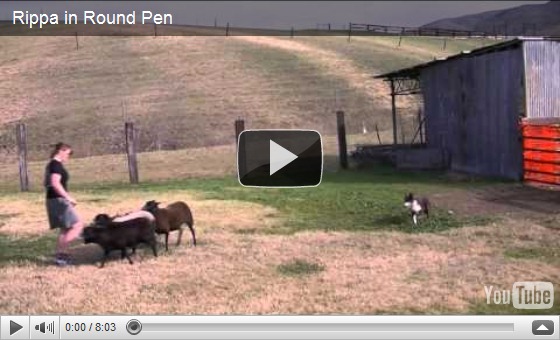
So here’s eight minutes of me and the dog . . . WITH ANNOTATION GOODNESS!